

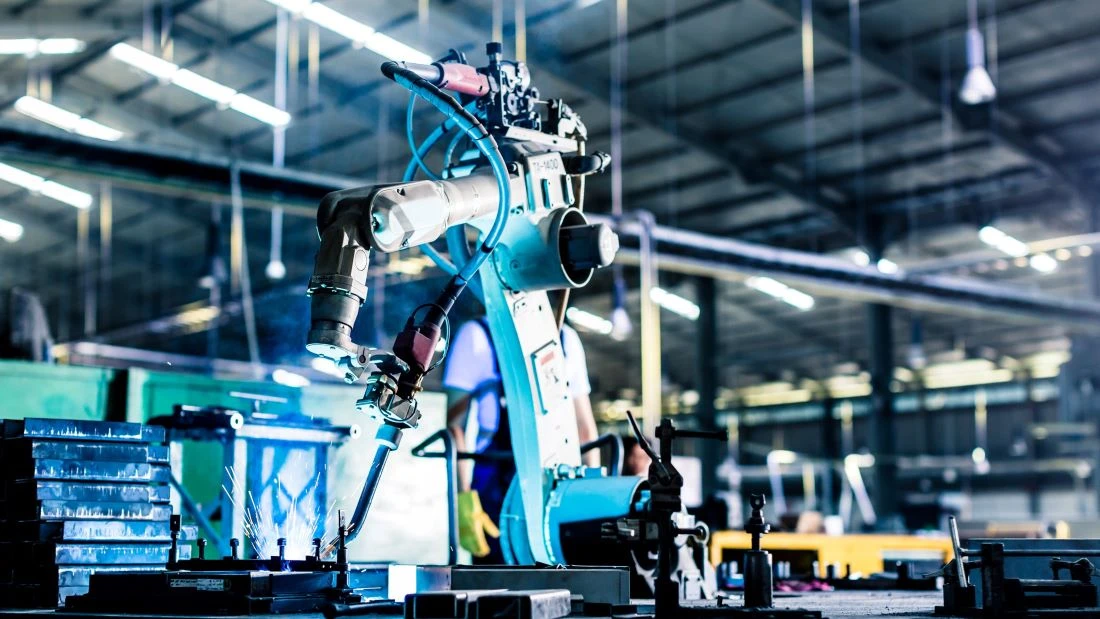

TNO: Without robotisation, the manufacturing industry will disappear
The Dutch manufacturing industry produces too little, and only extensive robotisation can help. So says TNO in a report presented yesterday in the factory hall of automation company AWL.
In the Experience Centre of automation company ALW, two machines stand in a glass booth. One takes boxes from the belt with its automatic gripper arms and places them on a tray, after which the other turns them into neat stacks with its gripper arms. These stacks are then tipped over, to repeat the trick over and over again.
'Just a week ago, this demo set-up was on display at a trade fair in Stuttgart,' says Brand van 't Hof, former managing director and now senior consultant at AWL. Cameras register the position of the boxes, and thanks to smart programmes supported by AI, the machines know what to do with them.
Report
AWL makes robotised solutions for the automotive, metalworking and intralogistics industries in particular, making it the perfect place for the presentation of TNO' s report on the role robotisation plays in the future of manufacturing.
Without robotisation, the Netherlands will no longer have its own manufacturing industry in ten years' time, is the looming thesis with which this presentation begins. This is because competition, particularly from Asia, is fierce, and without robotisation, production speeds will be too slow to keep up. To restore its competitive position, the productivity of the Dutch manufacturing industry must grow at least 50 per cent in the coming years, TNO argues.
This is important, says Claire Stolwijk, chief strategy and policy consultant at TNO, because the manufacturing industry accounts for 7 per cent of Dutch GDP and thus provides earning power. The Netherlands is good at coming up with beautiful innovations, but for their production companies too often go abroad.
The gloomy forecasts, referring to Mario Draghi's report on Europe and Peter Wennink's report on the Netherlands, sound familiar - for instance, from similar analyses for the Dutch or European high-tech sector and digitalisation task.
Numbers
Dutch manufacturing companies use 264 robots per ten thousand employees, says Mark Courage, director of smart industry at TNO, ranking twelfth worldwide. In South Korea it is more than a thousand, in China, Germany and Japan between four hundred and five hundred robots per ten thousand employees.
TNO therefore advocates a national robotisation agenda. Policy is currently too fragmented; there is a need for central direction, writes the knowledge institute.
'We must stop all reinventing the wheel,' says Courage, 'we can better work together and make it a bicycle. Standardisation is one of the things needed for this. Then machines will be usable by multiple parties.
Education
At the moment, the momentum is not really there yet. Of the automation machines made by AWL, less than 5 per cent remain in the Netherlands, says Van 't Hof. Solutions must be sought in more awareness and knowledge sharing, but also in training people who can make and operate robots, he says. The company therefore focuses not only on producing machines, but also on learning, innovation and validation. It has strong ties with educational institutions such as Windesheim Zwolle and innovation centre Perron 038, where companies and students work together.
Jan de Vries, experience centre coordinator at AWL, teaches the minor 'Factory of the Future' at Windesheim, and AWL itself runs a training programme 'Robot programmer in 100 days'.
'Look,' says De Vries. 'This robot was programmed by an MBO student with us.' The machine plays four-in-a-row, accurately pushing discs into the correct openings to do so while the user switches from player 1 to player 2. This is cleverly done, although the game itself is not particularly exciting: while player 1 builds a vertical row of four stones, player 2 places his stones around it rather randomly. Player 1 wins with ease.
Hopefully the Dutch manufacturing industry will do the same.

Opening image: TNO




Comments