



A controlled risk
A ride on a rollercoaster is considered the spectacular highlight of any visit to an amusement park. When designing them, engineers push the limits of what the materials and our bodies can just about withstand.
That high, that fast and that long? Even many seasoned rollercoaster enthusiasts thought it must be a publicity stunt. Yet, on the last day of last year, Falcons Flight opened in Saudi Arabia. Six Flags Qiddiya City’s new crowd-puller smashed every major rollercoaster record in one fell swoop.
Reaching speeds of up to 250 kilometres per hour, the Falcons Flight train hurtles along a 4.25-kilometre-long track, plunging down from a 200-metre-high cliff along the way. Park visitors experience 3.5 minutes of pure adrenaline. Looking at it through an engineer’s eyes, you see not only a spectacular rollercoaster but, above all, what is possible when specialists in mechanical engineering, civil engineering, materials science, software development, electrical engineering, manufacturing technology and safety engineering join forces to create the ultimate rollercoaster experience.
Engineers often solve societal problems. They design bridges, flood defences, power stations and medical equipment, thereby making the world a little better. But sometimes the world doesn’t need to be better – it just needs to be a bit more fun. Rollercoaster design falls into the latter category. They are built for one purpose: to let people experience the thrill of life-threatening danger for a short time without actually being in any danger. They manage this remarkably well. Statistically speaking, a visitor is far more likely to have a serious accident on the way to the amusement park than for anything to go wrong during a ride on a rollercoaster.

Dream job
The rollercoaster industry exerts an almost irresistible pull on many young engineers. Frank de Ruiter, managing director of rollercoaster manufacturer Intamin Holland in Apeldoorn, regularly realises that he doesn’t work for just any company. Schoolchildren often stop at the entrance to take photos of the office bearing the company logo. ‘I have colleagues who knew even as children: “One day, I want to work here.”’
Har Kupers, chairman of the supervisory board and former CEO of Vekoma in Vlodrop, recognises this. ‘As a rollercoaster manufacturer, we work on a fantastic product. Our people are incredibly proud of what they make.’
Behind every rollercoaster lies a complex system in which numerous engineering and other disciplines come together. ‘People mainly see steel,’ says Kupers. ‘In reality, a modern rollercoaster is a combination of mechanics, electronics, software and human factors.’
Kupers should know. Last month, King Willem-Alexander and Queen Máxima visited Vekoma to help celebrate its centenary. Vekoma was founded in 1926 as Veld Koning Machinefabriek, a company that manufactured agricultural machinery. The turning point came just over half a century ago. That was when the company began building Ferris wheels and other simple attractions, followed in 1977 by its first roller coaster.
‘At the time, that was a logical economic decision,’ says Kupers. ‘Traditional steel construction was under pressure and the owner was looking for a way to create more value per kilo of steel.’ Vekoma has now been the preferred supplier to Disney theme parks for 35 years, setting the standard for the entire sector. ‘Every year, we transport half a billion people,’ says Kupers. The company has not forgotten its roots, however: visitors are welcomed with fresh vlaai.

RollerCoaster Tycoon
In the past, rollercoaster engineers would design an attractive track and then come up with a story to go with it. Nowadays, every rollercoaster starts with a strategic question. Does an amusement park want an attraction that younger children will also enjoy, or should it opt for a spectacular thrill coaster instead? What role should the ride play in the park’s wider narrative? ‘We start with the desired G-forces and the visitor experience,’ says Kupers. ‘Based on those parameters, software generates the optimal track.’
Then there are other constraints too. What is the desired capacity: seven hundred visitors per hour or at least twelve hundred? How much space is available in the theme park?
‘A lot of people think we spend the whole day playing RollerCoas
’ Tycoon,’ says De Ruiter, referring to a computer game in which everyone builds their own theme park. ‘But designing the track layout is only a small part of the job.’

Vibrations
One factor that can make a rollercoaster ride not only unpleasant but even dangerous is vibration. Jurnan Schilder once carried out research into this whilst on an internship at Vekoma. It was no coincidence that his final-year internship took him to Vlodrop. Ever since he’d been introduced to the world of rollercoasters on a school trip to Walibi, Schilder had been hooked. ‘I already knew in secondary school that I wanted to become a rollercoaster designer. That’s how fascinated I’d become. Not even by riding them, because I found that rather scary at first. It was all about that little train, moving so elegantly along the tracks.’
Schilder tried to work out which degree programme would best help him realise his dream. ‘For the systems, electrical engineering is most useful; for the foundations, it’s better to choose civil engineering; and for work on the trains and the restraint systems, industrial design might come in handy. But, I thought at the time, mechanical engineering would be the most useful of all. So that’s what I went on to study, here in Enschede.’
He devoted his Master’s thesis to vibrations. Designers calculate an ideal track with a smooth acceleration profile. That combination of speed and curvature creates the primary sensations that determine the experience of a ride. ‘But during actual production, inaccuracies arise in the factory, and then the installation has to be taken into account as well. So what the train actually does in the end differs slightly from the design. This can lead to high-frequency vibrations that make a journey an unpleasant experience for passengers, but which are also undesirable from a technical point of view: the vibrations accelerate material fatigue.’

The very limit
G-forces play a key role in the design. A rollercoaster must feel thrilling, but must not exceed the physiological limits of the human body. That is why, during the design phase, calculations are carried out not only for the stresses in the steel structures, but also for the forces acting on the passengers’ heads, chests and navels.
The maximum accelerations are laid down in European standards. For family roller coasters, designers remain well below those limits, with G-forces of up to 2. With extreme thrill coasters, however, the aim is to find the very boundary between thrills and comfort for the ultimate adrenaline rush. G-forces can then vary during the ride from -1 – when that brief sensation of weightlessness occurs – to +5 in a sharp bend. ‘We can now determine exactly what is still possible,’ says De Ruiter. ‘We can then choose whether to push the design right up to that limit or to stay a little further away from it.’
Ahead of the curve
Sometimes innovation outpaces regulation. Vekoma experienced this in the late 1990s during the development of the first flying coaster. On this type of roller coaster, passengers do not sit upright, but hang or lie horizontally beneath the tracks, as if they were flying. ‘The G-forces are the same,’ says Kupers. ‘But the direction in which those forces act on the body is completely different.’
At the time, there were no standards for this sort of situation. Engineers therefore had to investigate for themselves what loads were still safe. In doing so, they drew on medical literature, supplemented by knowledge from military aviation and the results of tests in centrifuges normally used for pilot training. In addition, Vekoma built a large test rig to test body positions, loads and safety systems. It was not until years later that this knowledge was incorporated into official standards. This illustrates how innovation in this sector often arises: first, something is developed; then its safety is proven – which can be a lengthy process – and only then are the standards adapted. It is no coincidence that rollercoaster manufacturers also sit on the standards committee.
Bending machines
Schilder swapped his ambition to become a rollercoaster designer for a job that might be even more enjoyable: he became a senior lecturer in mechanical engineering at the University of Twente. According to him, the fact that modern roller coasters run more smoothly than the previous generation from the 1990s is mainly due to improved manufacturing techniques for the physical components.
In the past, tracks were constructed from successive circular segments that were welded together. Nowadays, computer-controlled bending machines can create a gradual curve, eliminating abrupt transitions.
Meanwhile, vibrations remain difficult to prevent, says Schilder. ‘Whereas we used to install the same roller coaster with the same layout perhaps as many as thirty times, today’s popular roller coasters are all bespoke. Each with its own production and installation errors.’
As well as the tracks, the trains have also improved. The wheels of a train sit close to the track. But to be able to negotiate a bend, there needs to be some play between them: that explains the rattling noise. Nowadays, however, wheel sets can rotate independently of one another, and the side wheels are pressed against the track by a spring. ‘That way, they maintain constant contact with the rails, and you’re rid of the impact load and vibrations,’ says Schilder.
Nevertheless, roller coasters are still being commissioned that turn out to exhibit unwanted vibrations. It is difficult to rectify this once it has happened. Would different material for the wheels help? Does the coating make a difference? Does the problem lie in the track foundation, the geometry or the running surface? ‘It does sometimes happen that an opening is postponed,’ says Schilder. ‘Sometimes the roller coaster is simply put into operation, but then closes again after a few months due to fatigue issues.’ In both cases, this represents a financial blow for the amusement park.
Two years ago, in September 2024, Schilder launched the world’s first minor’s programme in roller coaster engineering. Over the course of ten weeks, thirty students work their way through the entire design process in broad terms. ‘I’ve found several manufacturers willing to come and explain how to design a roller coaster, calculate the structural requirements, work on launch and braking systems, design the train – you name it.’ This autumn, the first students to have taken this minor will graduate. ‘They’re incredibly keen to get started in the industry,’ says Schilder.
One and a half million elements
One of the experts coming to teach is Frank de Ruiter from Intamin Holland. That company was founded in the 1970s as an engineering firm and originally designed and manufactured fairground rides. It was later taken over by global player Intamin. De Ruiter explains how 3D CAD systems and finite element analysis have fundamentally changed the design process. Fifteen years ago, a model with 200,000 elements was considered impressive. Nowadays, simulations sometimes contain more than one and a half million elements.
‘You used to calculate stress peaks by hand in places where you expected them, but you didn’t do that everywhere, and certainly not to an accuracy of one tenth of a pascal,’ says De Ruiter. ‘In today’s software, we can see every tiny stress peak, even those that used to remain hidden.’ These peaks can then be eliminated. A small change to the geometry, a slightly larger fillet radius or a subtle modification to a weld transition can have major consequences. ‘By optimising the geometry in this way, we achieve smoother transitions,’ says De Ruiter, which also helps to extend the structure’s service life.
Has all that computing power made the work any easier? De Ruiter isn’t sure. ‘The strange thing is that it hasn’t actually reduced the amount of calculations we do,’ he says. ‘Because the certifying bodies now want to see more and more calculations to determine whether an attraction meets all the standards and is therefore safe.’

Extremely strong and super-light
Greater computing power does, however, make lighter designs possible. Falcons Flight is a good example of this. The train uses a chassis milled from aluminium instead of welded steel structures. The safety bars are made from extremely strong yet super-light carbon-fibre composite. De Ruiter: ‘Every kilogram of weight saved has an impact throughout the entire chain. Lighter trains mean lower loads on rails, foundations, support structures and wheels.’
This also makes the record-breaking rollercoaster at Six Flags Qiddiya a major technological leap forward. The likelihood of a similar ride being built in Flevoland is not high – after all, making use of the local topography, with its steep rock faces which meant that tubes did not need to be too thick or too high, was crucial here. But some of the techniques developed specifically for the Saudi exa coaster (a category coined by Intamin for the most extreme roller coasters) will certainly be emulated, says De Ruiter: from the large-scale use of carbon fibre or glass fibre-reinforced polyester to the large, open spoked wheels that rapidly dissipate heat.
Robotisation
It is not just the design that is changing. Production is also becoming increasingly automated. According to Kupers, much of the complexity of a roller coaster lies not in the welding itself, but in the positioning of all the components that make up the track. Traditionally, this was done using large jigs and a great deal of manual labour. Vekoma has therefore developed systems in which robots receive coordinates directly from the engineering systems. ‘The robot knows exactly where a component needs to go and positions it automatically,’ says Kupers. After all, the more accurately the rails are produced, the smoother the ride will ultimately be.
New production methods also play a role. For example, Vekoma introduced the bending machines that Schilder mentioned earlier, which allow three-dimensional rail shapes to be produced directly, without the need for multiple successive forming steps.
Every year, between fifty and a hundred new roller coasters are opened worldwide, the vast majority of which come from Vekoma, Intamin and a handful of other suppliers. The construction period ranges from six months for a smaller ride to two years for a larger and more complex one.
All these roller coasters consist of thousands of components, which are often shipped from different countries to a single location. Local contractors carry out the foundations and civil engineering work. Specialised assembly teams then erect the structure. This is followed by an extensive testing programme. ‘Before visitors board, an attraction has often already undergone thousands of test cycles,’ says Kupers.
Moreover, it is not just the ride itself that is tested. ‘Ultimately, you’re not just designing a rollercoaster,’ says Kupers. ‘You’re designing a complete logistical machine.’ That entire process plays a part in the overall experience, including the management of visitor flows, often involving dual stations, separate boarding and alighting procedures, and complex logistical controls.
Reliability
Traditionally, rollercoaster manufacturers sold steel, trains and control systems. That has changed. Sensors, data analysis and predictive maintenance are making it increasingly possible to predict faults before they occur. As a result, the focus is shifting from manufacturing a product to providing a long-term service. ‘Ultimately, we don’t want to sell a rollercoaster,’ says Kupers. ‘We want to sell an experience and availability.’
For theme parks, this is desirable. An attraction that is out of action costs money immediately and leads to complaints on social media within minutes. Reliability and availability are therefore considered decisive design parameters.
Intamin generally remains involved throughout the entire life cycle of the roller coasters it has installed, via its after-sales department. In some cases, this can even last for more than thirty years, says De Ruiter. Maintenance on the rides usually takes place in the evening and at night. In the past, parks often remained closed during the winter. That period provided ample opportunity for all kinds of maintenance. Nowadays, however, some parks no longer close for the winter at all.

Calculated down to the millimetre
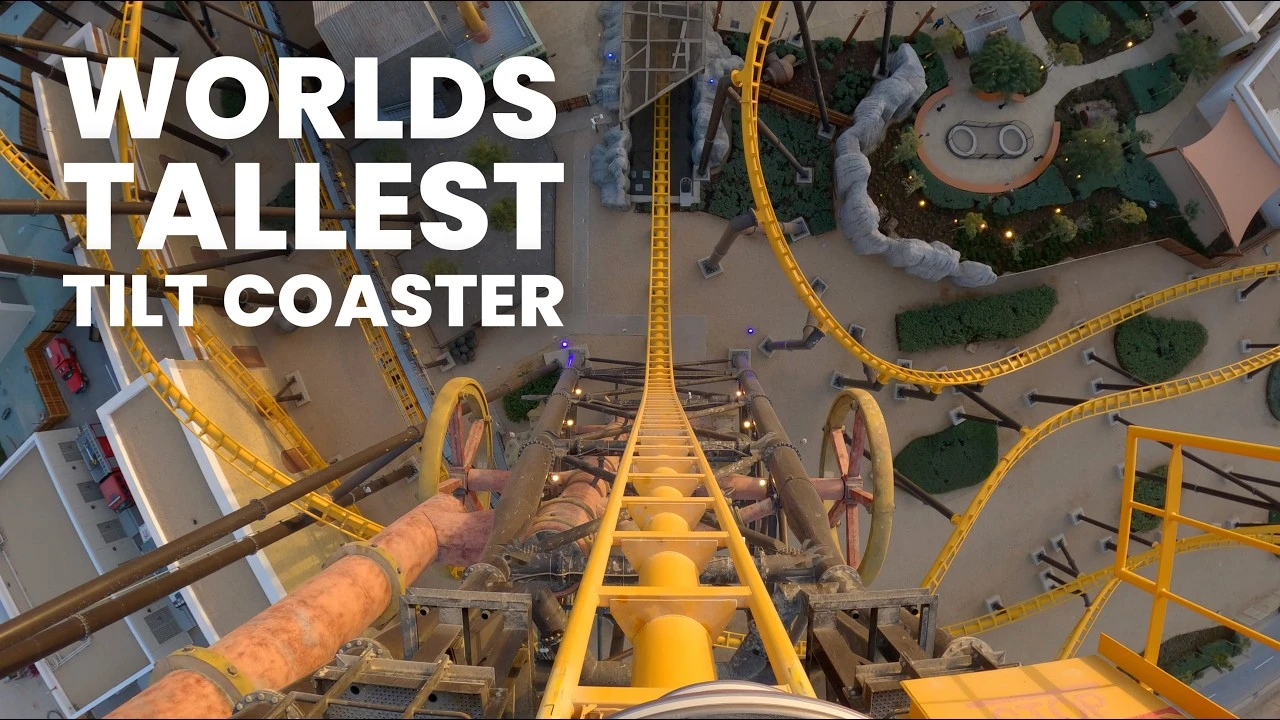
So that ride, which sends an amusement park visitor into a state of total excitement within two minutes, is the result of years of engineering work. But it’s just like theming: above all, the visitor mustn’t feel as though they’re part of a contrived experience. It has to feel real; the technology must remain as invisible as possible. The best rollercoasters feel incredibly dangerous, whilst in fact they are extremely safe. The sudden movements seem random, the freefall seems like a fatal mistake – certainly on Vekoma’s latest tilt coaster, where a section of the track suddenly tilts 90 degrees and sends the riders plummeting vertically into the abyss.
Of course, everything has been calculated down to the millimetre. That is perhaps the greatest achievement of the rollercoaster engineer: designing an experience that makes visitors believe the laws of physics no longer apply for a moment, whilst in fact they are being applied and utilised to the very limit. ‘People come for fun and thrills,’ Kupers sums up. ‘But behind that fun lies one of the most meticulously calculated and controlled technical systems you can imagine.’





Comments