



Breast milk robot reduces workload in the neonatal intensive care unit
In the intensive care unit for premature or newborn babies, nursing staff spend a great deal of time preparing feeds with the utmost precision. Paediatrician Tom Ouwehand, co-founder of the start-up Neollie. This would give nurses more time to provide direct care for the babies.
The neonatology department cares for babies who are born prematurely, have a low birth weight, or experience medical complications or conditions immediately after birth. For these babies, breast milk is the very best thing there is, says paediatrician and neonatologist Tom Ouwehand of Erasmus MC, on LinkedIn. ‘It helps them grow well, but sometimes they need assistance because they are still too small to feed or because they have a condition that prevents them from doing so.’ They are then fed breast milk via a feeding tube.
Accurate to the millilitre
The fridge contains the supply of breast milk that the babies in his ward will be fed over the next 48 hours. Every day, in this ward alone, two nurses spend four hours measuring out and distributing expressed breast milk with millilitre precision. The milk is dispensed into syringes for babies who are not yet strong enough to feed themselves, and into bottles for the premature babies who are already able to do so. Protein and fat powder are often added to this as well. Everything also has to be mixed and warmed up before being administered via a feeding tube.
‘A premature baby, for example, receives ten millilitres of feed twelve times a day, and a few per cent of protein and fat powder must then be added to that,’ says Ouwehand. This is a time-consuming process and, despite all the care taken, one that is prone to errors. There must be a smarter way, thought the paediatrician, who also has a great passion for technology. Together with Erasmus University Rotterdam and Delft University of Technology, he is working on a breast milk robot that takes over the task of preparing syringes and bottles. This robot ensures that the feed – whether cold or even frozen – is accurately measured, mixed with the powder and then delivered warm to the feeding tube.

Complex operations
Ouwehand is a co-founder of the Delft-based start-up Neollie, which is developing the precision robot. The small company grew out of a minor in robotics at Delft University of Technology. According to the students, the technical implementation was still quite complicated. The robot must not only dispense milk with great precision, but also open and close bottles, add powders and mix them with the milk, fill the syringes and store the end result in a cool place or heat it immediately and prepare it for dispensing. In addition, a gripper capable of rotating more than 360 degrees is required to loosen and tighten caps. Whilst this is technically feasible, the development is costly. Thanks to an innovation voucher from Kansen voor West, the start-up was able to further develop the technology at TU Delft’s RoboHouse.
More time for patients
Ouwehand is certainly enthusiastic about the test with the prototype. A third prototype is now in the pipeline. ‘Our latest robot can mix formula for twenty babies with microlitre precision. The nurses receive a notification on their phones when the feed is ready for the baby,’ says Ouwehand.
This year, the start-up aims to get the entire process up and running and test it in collaboration with the relevant parties and the hospital. If all goes well, the robot will be put into service in 2029. Ouwehand: ‘Then carers and nurses will once again have time to do what they love most: looking after their patients.’

Neo
The development of the Neo milking robot, under the name NEOPERFECT, is also part of the WorkTech healthcare innovation programme, which promotes labour-saving innovations in health, wellbeing and care. WorkTech, an initiative of Medical Delta, InnovationQuarter and ZWconnect, is co-funded by a PPP grant from Health Holland.
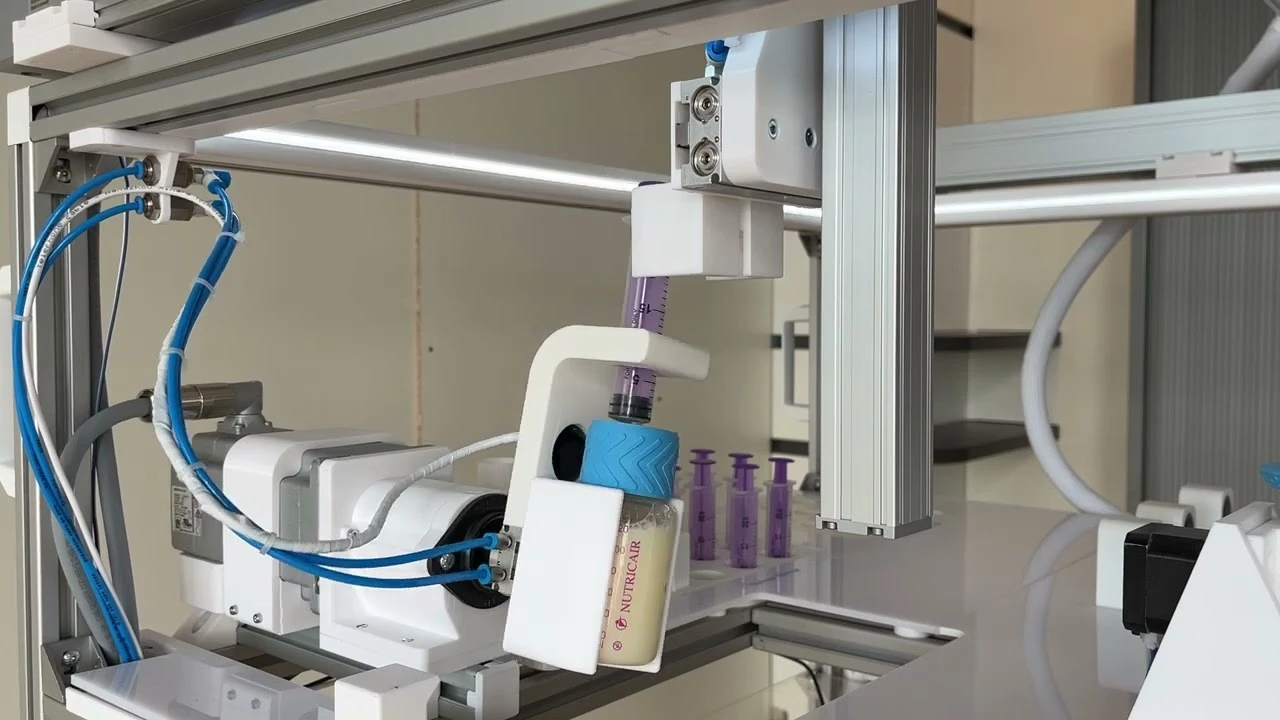
Opening photo: The syringes filled with breast milk on the Neo breast milk robot. Credits: Neollie.


Comments