

The engineers of tomorrow
A small iron ball that stores energy. A circular solution for electronic waste. And a robotic suit that helps people with spinal cord injuries to walk. Teams of students are working on a wide range of practical technical challenges. The KIVI Engineering Student Team Award recognises these young engineers for their work.
One student is building a prototype, another is working out the maths behind a technical problem, and further along, a design is being reworked. For student teams, it’s not just about what’s learnt in the lecture theatre. Students must also apply the knowledge they gain there outside the regular study programme. The projects undertaken by Dutch engineering student teams vary widely, but what they have in common is that they bring together knowledge from different disciplines and turn an idea into a working technology. To this end, the teams collaborate with companies and researchers and build prototypes that are tested at trade fairs, in laboratories or during international competitions.
Since 2022, KIVI has been putting these teams in the spotlight with the Engineering Student Team Award. The award was established partly on the initiative of Princess Mabel to highlight the achievements of engineering students, raise the profile of their innovative projects and encourage their development. In this article, the winners of the three previous editions demonstrate the various directions in which ambition can take them.
Storing energy in iron
Hydrogen storage is one of the technical issues that student teams are focusing on. Hydrogen can play a role in a sustainable energy system, but its storage and transport present technical challenges. Gaseous hydrogen requires suitable storage facilities, and liquid hydrogen also places high demands on the infrastructure. Team SOLID from Eindhoven University of Technology is investigating an alternative: storing the energy in iron and transporting this instead of hydrogen.
This principle is based on a chemical cycle in which iron and steam react to produce hydrogen and iron oxide. The hydrogen released can be used as an energy carrier. By subsequently reducing the iron oxide again, the cycle can be repeated. In this way, the material – which can be stored and transported relatively easily – acts as a kind of rechargeable energy carrier. With the Steam Iron Reactor One, the students built a pilot setup to test the principle.
Team SOLID has been in existence since 2016 and works with successive cohorts of students on the development of the technology. This requires more than just materials technology, sound technical design and the fine-tuning of chemical processes. New team members must familiarise themselves with the project, acquire the necessary knowledge and build on the work of their predecessors. At the same time, the project must maintain sufficient continuity to achieve results in the longer term.
In 2024, Team SOLID won the KIVI Engineering Student Team Award. The jury recognised the potential of the technology, which, with further development and upscaling, could contribute to the energy transition. In addition to the innovative aspect, the award also recognises the organisational skills required to advance this technology. SOLID demonstrates how students are already confronted with issues during their studies that are also of importance to industry.

From electronic waste to raw materials
A year earlier, the award went to CORE Changemakers, also from Eindhoven University of Technology. This team focuses on the circular economy, with a particular emphasis on technologies that can improve the processing of electronic waste. Discarded devices such as mobile phones or computers contain materials that can be reused, but recovering these is not straightforward because different materials and components are tightly integrated. This requires suitable technology and a different approach to managing raw materials.
The ambition goes beyond simply developing a single recycling machine: CORE aims to contribute to the transition to a circular economy by developing new technologies, strengthening knowledge and expertise in recycling and material reuse, and enabling students to gain experience with circular innovations. This calls for a different approach to design. For a product designed with reuse in mind from the outset, it is not just how well it functions during use that matters. The way in which materials can be dismantled, separated and reused afterwards also plays a role.
On the KIVI website, Dirk van Meer, CEO of CORE Changemakers, talks in a video about the significance of taking part in and winning the award. This perspective is relevant because the development of student teams does not stop at creating a prototype or attending an awards ceremony. Recognition can help to raise the profile of a project and initiate dialogue with potential partners, researchers and other interested parties.
Technology for a more inclusive society
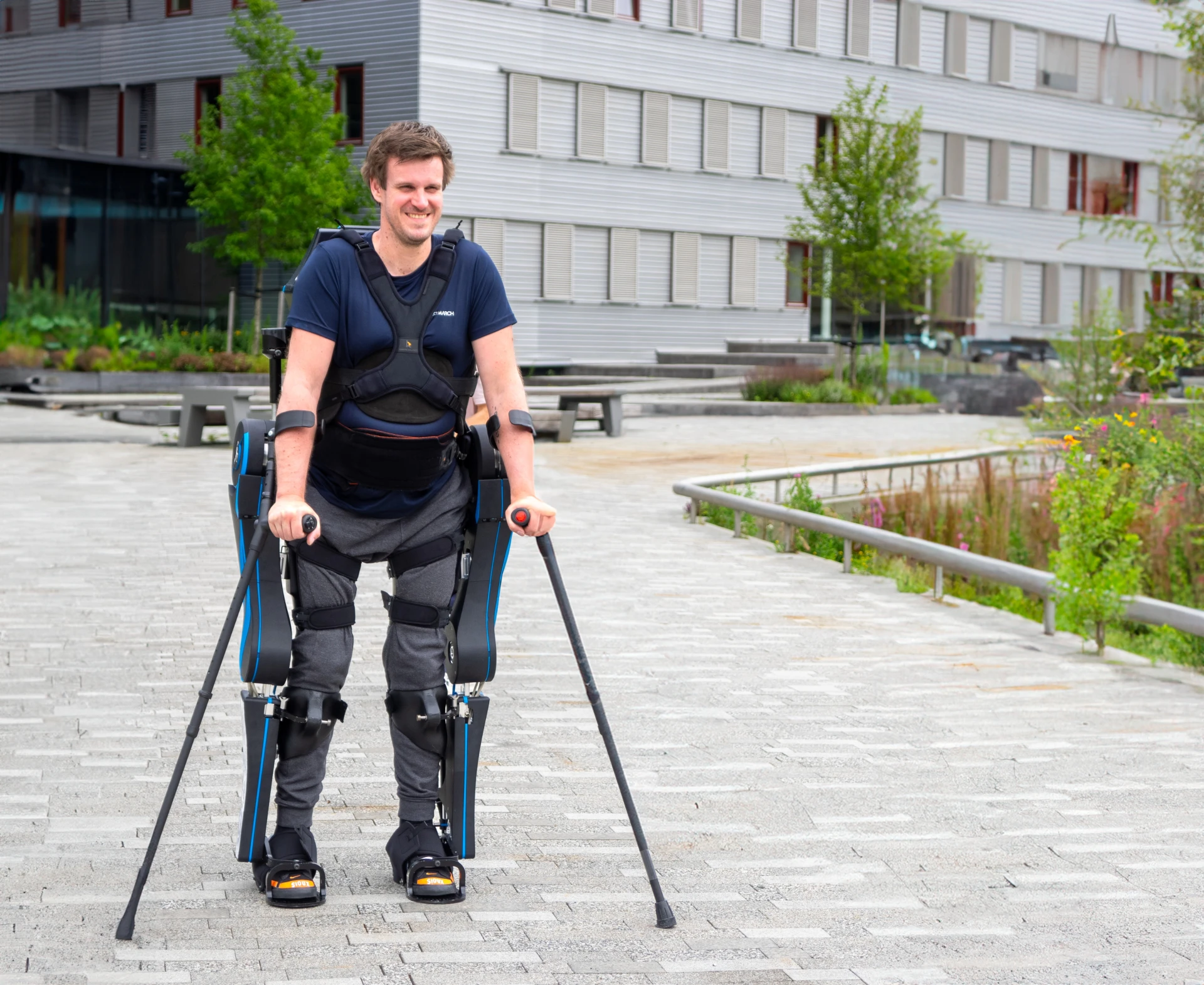
Project MARCH does not focus on energy storage or the reuse of raw materials, but on people’s freedom of movement. The student team from Delft University of Technology is developing a motorised exoskeleton for people with spinal cord injuries. With this wearable robotic system, the students aim to help people with complete or partial paralysis to stand up again and walk independently.
Every year, a new group of students works on a new prototype. Developing this requires a combination of mechanical engineering, electronics, robotics and control engineering. Medical knowledge is also important: movements must not only be technically feasible, but must also be suited to the user and their capabilities. This makes the project a technical challenge in which performance and human needs constantly intersect.
Project MARCH has been in existence since 2015 and operates as a non-profit team based on the open-source principle. The designs and knowledge gained are freely shared with the wider scientific and wider community. This enables other developers and researchers to build on the results. This approach underlines that the social value of a technical project lies not only in the end product, but also in the knowledge it generates.
In 2026, Project MARCH won both the jury prize and the public prize at the KIVI Engineering Student Team Award. This recognition highlights the team’s technical ambition and the social significance of the project – technical innovation can be directly linked to independence, accessibility and quality of life. It also demonstrates how a student team can tackle a problem that does not fall within a single technical discipline.

What makes a team special?
The previous winners of the KIVI Engineering Student Team Award demonstrate that there is no single path to outstanding technical achievement. One team develops a new energy system, whilst another seeks solutions for electronic waste or builds technology that helps people with physical disabilities to become more mobile. KIVI assesses the participating teams on four competencies: team spirit, innovative strength, social impact and expertise.
So it’s not just about the technical content. Sharing knowledge, bringing together different specialisms and working collectively towards a common goal also count.
This is important in projects that can last several years. Students come and go, designs change, and technical problems sometimes require a different approach to that initially envisaged. The continuity of a team is therefore almost as important as the idea with which it began.
The award provides a platform for these efforts. Not because every student project immediately leads to a practical innovation, but because it highlights how engineering students learn to tackle complex problems and explore technical possibilities.
Which team deserves the 2027 award?
The next winner of this award may not yet be known to the wider public. Perhaps a student team is currently working on a new energy system, a smart production technique or a solution to a social problem. A team that is not yet widely known, but which, through its approach, expertise and collaboration, demonstrates what young engineers can achieve. Do you know a team of engineering students who deserve this recognition? If so, nominate them for the KIVI Engineering Student Team Award 2027.Nominations are open until 24 November 2026. View the terms and conditions and nominate a team via the KIVI website.




Comments